
When an Occipital Headache Is Not “Just a Headache”
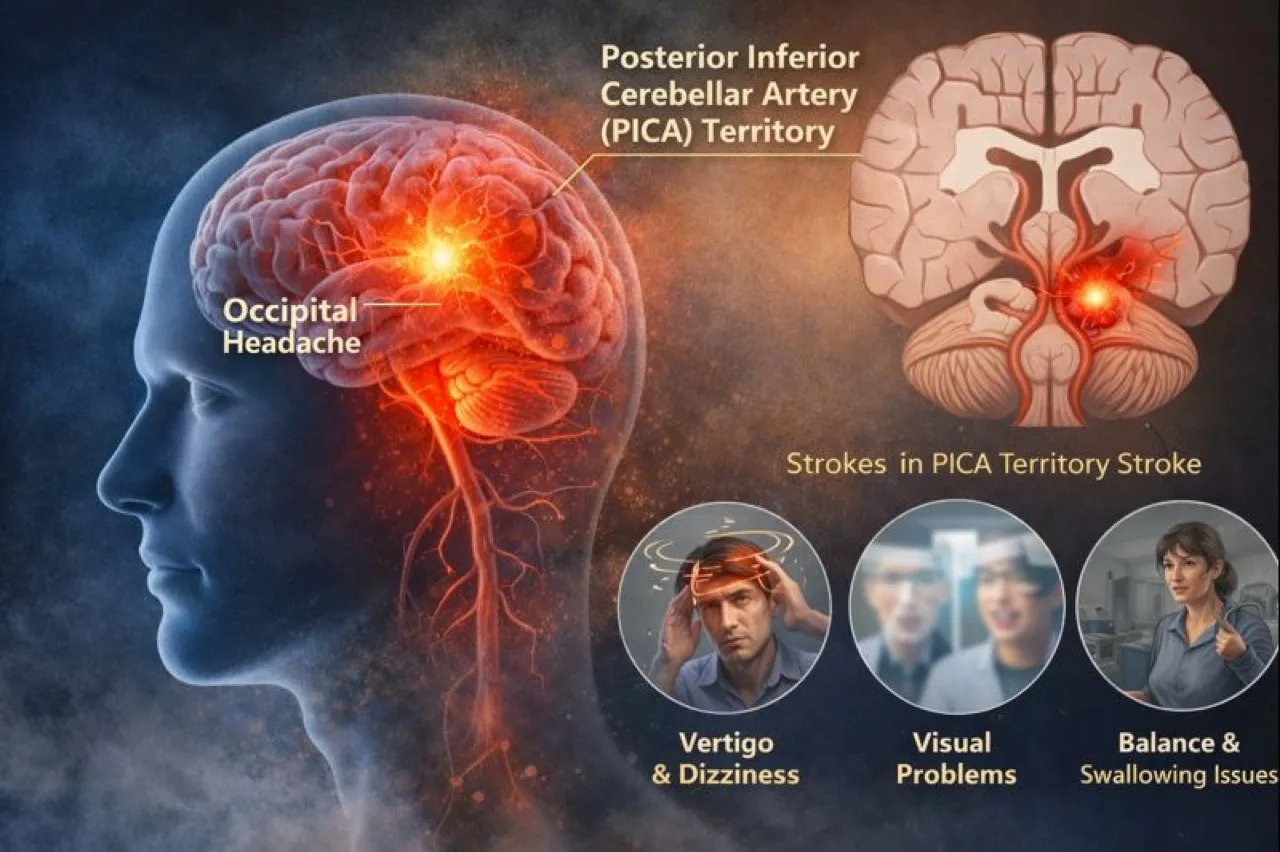
Understanding the Stroke Connection in the PICA Territory
Headache is one of the most common neurological complaints. Stroke is one of the most feared neurological diagnoses. Most of the time, the two live in separate boxes in a patient’s mind. Sometimes, dangerously, they live in separate boxes in a doctor’s mind too.
But there is a narrow, critical overlap where a headache is not benign, not migrainous, and not tension related.
One of the most important overlaps sits at the back of the head.
Why Occipital Headaches Deserve Respect
Occipital headaches are pain felt at the back of the skull, often described as deep, heavy, pressure-like, or throbbing. Patients frequently point to the lower back of the head or upper neck and say, “Doctor, pain is coming from inside.”
Most occipital headaches are musculoskeletal, cervicogenic, or neuralgic. That is true.
But not all.
When an occipital headache is sudden, severe, unfamiliar, or associated with neurological symptoms, the posterior circulation of the brain must be considered.
This is where strokes become relevant.
The Posterior Circulation and the PICA Territory
The brain’s blood supply is divided into anterior and posterior circulations.
The posterior circulation supplies the brainstem, cerebellum, occipital lobes, and vital balance centers. One of the most important arteries here is the Posterior Inferior Cerebellar Artery, commonly called PICA.
A stroke in the PICA territory can be subtle, deceptive, and easily missed.
Unlike large cortical strokes that cause obvious paralysis or speech loss, PICA strokes often begin quietly.
Sometimes with a headache.
How a PICA Stroke Can Present as a Headache
A PICA territory stroke often irritates pain-sensitive structures in the posterior fossa. This can produce a sudden occipital headache that feels different from prior headaches.
Red flags include:
• Sudden onset occipital headache
• Severe intensity at onset
• Associated vertigo or spinning sensation
• Persistent nausea or vomiting
• Gait imbalance or falling to one side
• Slurred speech
• Difficulty swallowing
• Double vision
• Numbness over the face
In some patients, headache is the first and dominant symptom, preceding neurological signs by hours.
This delay is dangerous.
Why These Headaches Are Commonly Missed
There are three reasons PICA strokes are often overlooked:
First, CT scans can be normal early, especially in posterior circulation strokes.
Second, symptoms like dizziness and vomiting are mistakenly attributed to gastritis, cervical spondylosis, or inner ear problems.
Third, patients are often younger than expected and may not have classic stroke risk factors.
An occipital headache plus vertigo is not “just migraine” until stroke is excluded.
Occipital Headache Versus Migraine: The Key Differences
Migraine headaches can involve the back of the head, but they usually have a prior history, gradual buildup, photophobia, or clear triggers.
A vascular headache from posterior circulation ischemia is different.
It is often abrupt, unfamiliar, relentless, and resistant to usual painkillers.
The patient often says, “Doctor, this is not my usual headache.”
That sentence matters.
Imaging That Actually Helps
For suspected posterior circulation stroke, MRI with diffusion imaging is far superior to CT.
MR angiography helps identify vertebral artery dissection, PICA occlusion, or basilar pathology.
Delay in imaging equals delay in diagnosis.
Delay in diagnosis equals permanent disability.
Why Early Recognition Changes Outcomes
Timely diagnosis allows:
• Antiplatelet or anticoagulant therapy when indicated
• Blood pressure optimization
• Prevention of brainstem compression from cerebellar edema
• Early neuro-rehabilitation
Missed PICA strokes can deteriorate suddenly due to swelling in a tight posterior fossa.
This is not theoretical. It is clinical reality.
The Take-Home Message
Not every occipital headache is dangerous.
But every dangerous occipital headache is often dismissed first.
If an occipital headache is sudden, severe, different, or associated with dizziness, imbalance, vomiting, or cranial nerve symptoms, stroke must be ruled out before reassurance is given.
At NeuroMet Wellness, we believe headaches should be understood, not normalized without thought.
Because sometimes, a headache is not pain.
It is a warning.
References (Reputed, Evidence-Based)
-
Caplan LR. Posterior Circulation Disease. New England Journal of Medicine.
-
Savitz SI, Caplan LR. Vertebrobasilar disease. New England Journal of Medicine.
-
Edlow JA et al. Diagnosis of acute dizziness and vertigo. Lancet Neurology.
-
American Heart Association and American Stroke Association Guidelines for the Early Management of Acute Ischemic Stroke.
-
Fisher CM. The posterior inferior cerebellar artery syndrome. Archives of Neurology.
Still have questions about your symptoms?
Get a professional diagnosis from Dr. Bhupesh Kumar. Early detection leads to better recovery.
Book ConsultationShare this article: